




Reverse recruiting is an emerging career service that takes a proactive, candidate-focused approach to the job search. Rather than leaving job seekers to identify opportunities, submit applications, and build professional connections on their own, reverse recruiters help manage and execute these activities on the candidate’s behalf.
As the field continues to grow, an important question is emerging: How can job seekers identify reverse recruiting professionals who have demonstrated the knowledge and skills necessary to provide this specialized service?
Professional certification is one way to establish that standard.
What Is the Reverse Recruiting Council?
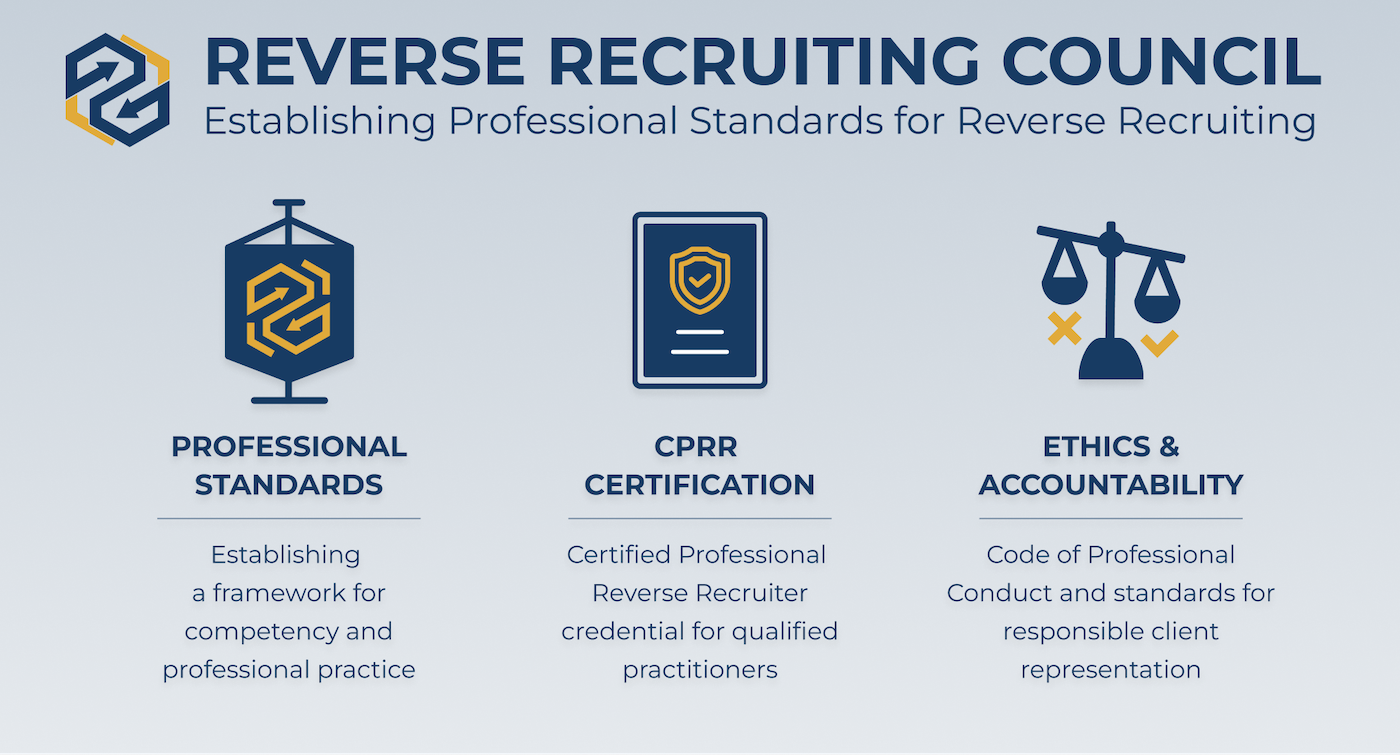
The Reverse Recruiting Council (RRC) is a professional organization dedicated to establishing standards, promoting ethical practices, and supporting competency within the reverse recruiting profession.
The Council developed the Certified Professional Reverse Recruiter (CPRR) designation to provide a structured professional credential specifically for individuals working in reverse recruiting.
Rather than applying general recruiting or career coaching standards to the profession, the CPRR program focuses specifically on the knowledge, skills, and practices involved in managing and executing a job search on behalf of a client.
What Is CPRR Certification?
The Certified Professional Reverse Recruiter (CPRR) is a professional credential administered by the Reverse Recruiting Council.
CPRR certification is designed for professionals who provide or plan to provide reverse recruiting services. The credential can be relevant to reverse recruiters, career coaches expanding into reverse recruiting, recruiting professionals transitioning to candidate-side services, and other career services professionals.
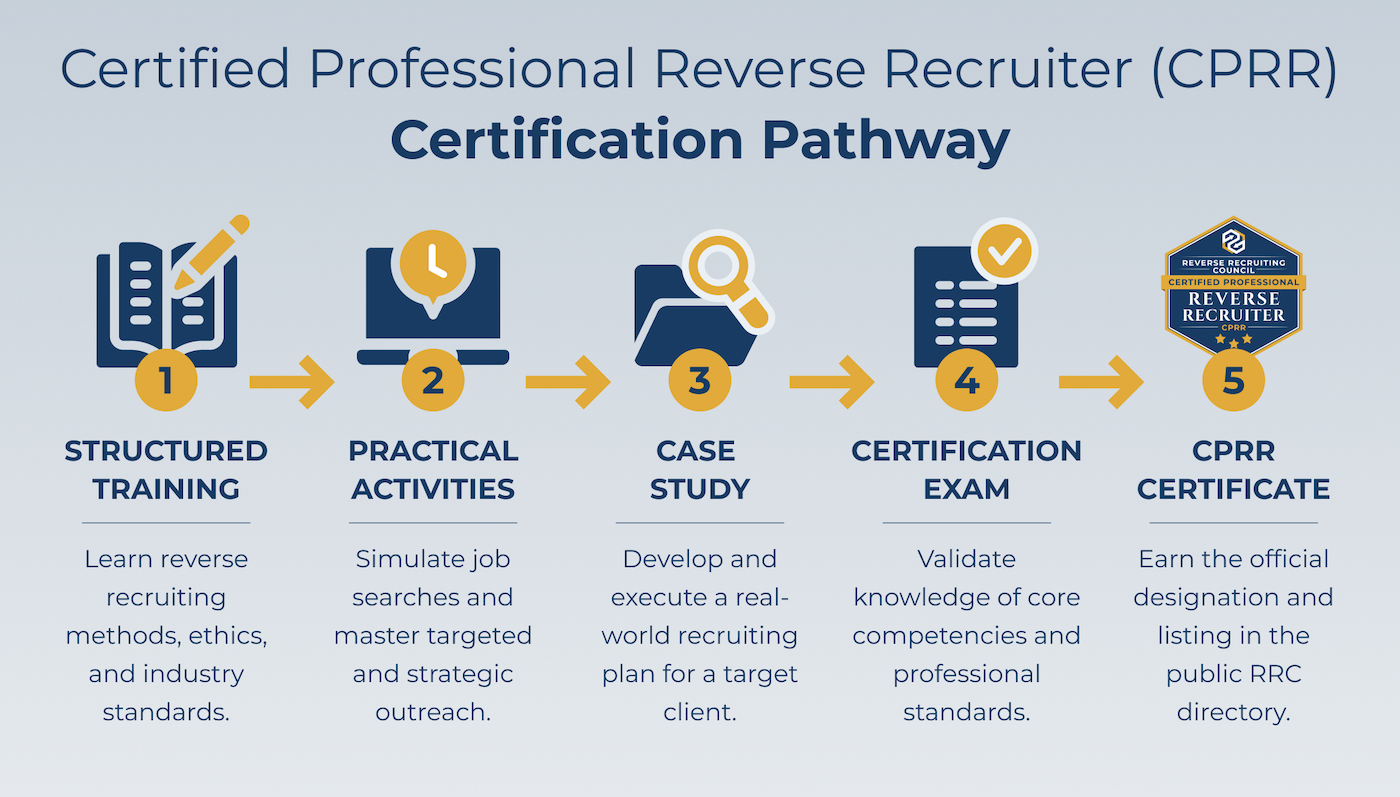
The program combines structured education with practical application and formal assessment.
Candidates complete approximately 5 to 8 hours of instructional content and 28 practical activities, followed by a written case study and a 50-question certification examination. A minimum score of 90% is required to pass the examination.
What Does CPRR Training Cover?
The CPRR curriculum addresses the major components of professional reverse recruiting, including:
Client Intake and Search Strategy
Candidates learn how to understand a client’s career goals, background, preferences, and objectives and use that information to develop an appropriate job search strategy.
Job Search and Application Management
The curriculum covers opportunity identification, company research, advanced search techniques, application strategy, resume customization, application tracking, and job search pipeline management.
Networking and Outreach
Proactive networking is a central component of reverse recruiting. Training covers direct and indirect networking, identifying hiring managers and other relevant contacts, LinkedIn and email outreach, messaging strategies, and communication cadence.
Technology and AI
CPRR training addresses the appropriate use of artificial intelligence and technology in reverse recruiting, including prompting, efficiency, and the limitations of relying on AI without professional judgment.
Client Experience
Reverse recruiters are responsible not only for executing search activities but also for maintaining an effective client relationship. The curriculum addresses communication, organization, expectations, and the overall client experience.
Ethics and Professional Conduct
Reverse recruiters may communicate with employers and hiring professionals on behalf of candidates, making ethical standards particularly important.
CPRR practitioners agree to follow the Reverse Recruiting Council Code of Professional Conduct, which establishes expectations for professional integrity, honesty, client representation, and responsible conduct.
What Makes a Professional Certification Meaningful?
Not all professional credentials represent the same type or level of training. When evaluating a reverse recruiting certification, job seekers and professionals may want to consider several factors:
- Defined curriculum: Does the program cover the actual work performed by reverse recruiters?
- Practical application: Are candidates required to demonstrate that they can apply what they have learned?
- Meaningful assessment: Does certification require an examination, case study, portfolio review, or another form of competency evaluation?
- Ethical standards: Does the organization maintain a formal code of professional conduct?
- Credential verification: Can clients independently verify that a professional holds the certification?
The CPRR program incorporates these elements through structured instruction, practical activities, a written case study, formal examination, professional standards, and a public directory of certified practitioners.
Why Do Professional Standards Matter in Reverse Recruiting?
Anyone can describe themselves as a reverse recruiter. As the profession develops, defined standards can help create greater consistency, accountability, and transparency.
Professional standards are particularly important because reverse recruiters may represent candidates in communications with employers and hiring professionals. Practitioners need to understand not only how to conduct an effective job search, but also how to represent clients responsibly and ethically.
The Reverse Recruiting Council supports this process through its certification program, Code of Professional Conduct, and ongoing professional standards.
How Can You Verify a CPRR-Certified Professional?
The Reverse Recruiting Council maintains a public directory of certified professionals, allowing prospective clients to verify practitioners who hold the CPRR designation.
For job seekers considering a reverse recruiter, certification can be one factor to consider alongside a professional’s experience, services, approach, and track record.
The Future of Reverse Recruiting Certification
Reverse recruiting is still a developing professional field, and professional credentials will continue to evolve as the industry grows.
The Reverse Recruiting Council was established to help provide structure to that development through professional education, certification, ethical standards, and accountability.
The CPRR designation gives practitioners a formal way to demonstrate specialized knowledge in reverse recruiting while giving job seekers a credential they can consider when selecting a professional to assist with their career search.
As reverse recruiting continues to develop, standardized education and professional credentials can help distinguish trained practitioners and promote greater confidence in the profession.